

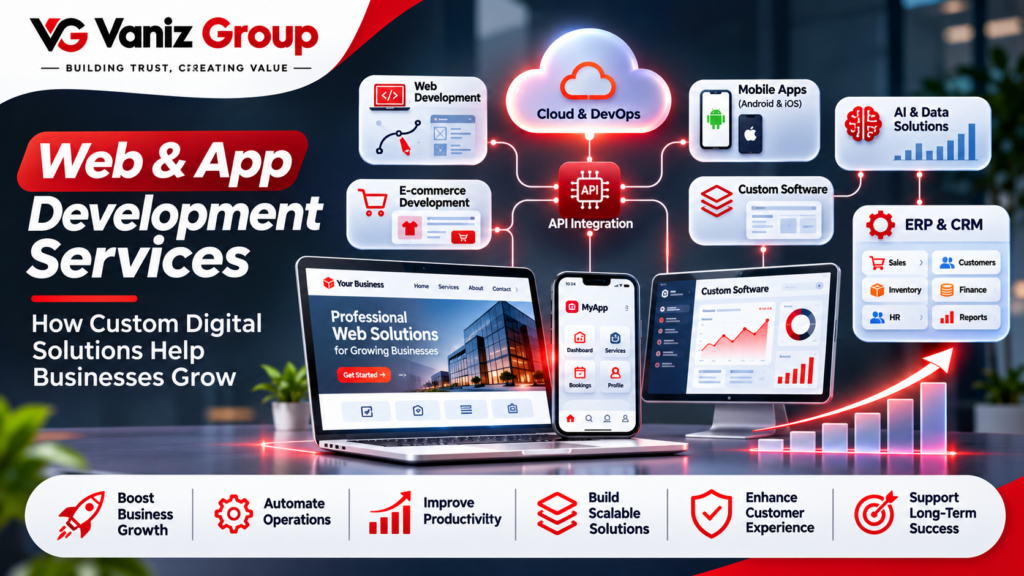
Businesses today need more than a basic online presence to remain competitive. Customers expect fast, user-friendly websites, convenient mobile applications and digital services that make everyday interactions easier. At the same time, organisations need reliable software to manage operations, improve productivity and support business growth.
This is where professional web and app development services make a difference.
Whether you are a startup launching a new business idea, an established company modernising its operations or an organisation looking to build a digital product, investing in the right technology can help you achieve your objectives.
From responsive websites and e-commerce platforms to mobile applications, ERP systems and custom business software, modern development solutions allow businesses to create digital experiences around their specific requirements.
At Vaniz Group, we help businesses plan, design and develop digital products, software applications and technology solutions that support their operations and future ambitions.
In this article, we explore the different types of web and app development services, their business benefits, important technologies and how to choose the right development partner.
1. What Are Web and App Development Services?
Web and app development services involve designing, building, testing and maintaining digital applications that help businesses operate, communicate with customers and deliver services online.
These solutions can range from simple business websites to complex web platforms and mobile applications with advanced functionality.
Some of the most common development services include:
- Website design and development.
- Custom web application development.
- Android and iOS app development.
- E-commerce website development.
- Enterprise software development.
- ERP and CRM development.
- UI/UX design.
- API development and integration.
- Cloud application development.
- AI-powered business solutions.
The right solution depends on the business model, target audience, operational requirements and long-term objectives.
2. Professional Web Development Services for Modern Businesses
A website is often the first point of contact between a business and a potential customer. It communicates your brand, presents your services and helps visitors understand what your organisation offers.
A professionally developed website should do more than look attractive. It should provide a smooth user experience, load efficiently, work across devices and support your business goals.
Business Website Development
A business website provides a central online destination where customers can learn about your company, explore services and make enquiries.
A professional business website may include:
- Homepage and company information.
- Service and product pages.
- Contact and enquiry forms.
- Customer testimonials.
- Portfolio and project showcases.
- Blog and resource sections.
- Responsive mobile-friendly layouts.
A well-structured website can strengthen your online presence and help potential customers find the information they need.
Custom Web Application Development
Some businesses need more than a traditional website. They require interactive platforms that manage users, information, workflows and business operations.
Custom web application development makes it possible to build software around specific business processes.
Examples include:
- Customer management platforms.
- Booking and appointment systems.
- Business management dashboards.
- Online marketplaces.
- Employee management systems.
- Reporting and analytics platforms.
- Customer portals.
- SaaS applications.
Custom web applications can be designed to match the way your business operates rather than forcing your team to adapt to software that does not fully meet your requirements.
E-commerce Website Development
An e-commerce website allows businesses to sell products and services online.
A modern e-commerce platform may include product catalogues, shopping carts, secure checkout, payment gateway integration, inventory management and order tracking.
Businesses can also benefit from additional functionality such as customer accounts, promotional offers, loyalty programmes and automated notifications.
Whether you are launching a new online store or improving an existing retail platform, the right e-commerce solution can support a more convenient shopping experience.
3. Mobile App Development for Android and iOS
Mobile applications have become an important part of how businesses interact with customers and manage services.
A dedicated mobile application can provide convenient access to products, services and business functionality through smartphones and tablets.
At Vaniz Group, our mobile app development capabilities cover modern technologies and platforms used to build applications for different business requirements.
Android App Development
Android applications allow businesses to reach customers using Android smartphones and tablets.
Depending on the project, an Android app can include user registration, notifications, payment integration, location-based functionality, booking systems and customer dashboards.
The development process focuses on building an application that is reliable, easy to use and suited to the intended audience.
iOS App Development
iOS app development involves creating applications for Apple’s mobile ecosystem.
Businesses may choose iOS applications to provide customers with a dedicated experience on iPhones and other supported Apple devices.
Features can include secure authentication, in-app purchases, push notifications, API integrations and personalised user experiences.
Cross-Platform App Development
Businesses that want to reach both Android and iOS users may consider cross-platform development.
Technologies such as Flutter and React Native can help developers build applications for multiple platforms using a shared codebase, depending on the application’s requirements.
This approach can reduce duplicated development work and simplify certain maintenance activities.
However, the best approach depends on performance expectations, device-specific functionality, project complexity and long-term support requirements.
4. Custom Software Development for Business Requirements
Every organisation has different operational requirements. Off-the-shelf software can be useful, but it may not always support specialised workflows or business processes.
Custom software development allows businesses to create applications designed around their specific needs.
Examples of custom software solutions include:
- Internal business management systems.
- Customer relationship management platforms.
- Workflow automation applications.
- Enterprise portals.
- Inventory and stock management systems.
- Reporting and analytics software.
- Industry-specific applications.
- Integration between existing business systems.
A custom solution can also be expanded as business requirements change.
The main advantage is flexibility: functionality, user roles, integrations and workflows can be planned around the organisation rather than relying entirely on predefined software features.
5. ERP Solutions to Improve Business Operations
Enterprise Resource Planning (ERP) software helps businesses manage different operational activities through a connected system.
Instead of maintaining separate tools for every department, an ERP platform can bring important business processes together.
Depending on the organisation’s requirements, an ERP solution may support:
- Inventory management.
- Purchasing and procurement.
- Sales and order processing.
- Finance and accounting workflows.
- Human resource management.
- Warehouse operations.
- Customer and supplier records.
- Business reporting.
A properly planned ERP system can improve operational visibility, reduce repetitive manual work and support more consistent information management.
Businesses can choose to implement an existing ERP platform, customise an available solution or develop a system around their particular operational needs.
6. UI/UX Design: Creating Better Digital Experiences
The success of a website or application depends not only on its technical functionality but also on how people interact with it.
User Interface (UI) design focuses on the visual elements of a digital product, including layouts, typography, colours, buttons and navigation.
User Experience (UX) design focuses on the overall experience, including how easily users can complete tasks and move through the application.
A professional UI/UX design process may include:
- User research and requirement analysis.
- User journey mapping.
- Wireframing.
- Interactive prototyping.
- Interface design.
- Responsive layouts.
- Usability evaluation.
Good UI/UX design can make digital products easier to understand, navigate and use.
For businesses, this can contribute to better customer experiences and more effective digital interactions.
7. Cloud and DevOps Solutions
Modern web applications and business software often depend on cloud infrastructure to operate reliably and support changing demand.
Cloud solutions allow organisations to use computing resources, databases, storage and other services without managing every infrastructure component themselves.
Cloud and DevOps services can support:
- Cloud application deployment.
- Infrastructure configuration.
- Application hosting.
- Automated build and deployment pipelines.
- Containerisation using Docker.
- Application monitoring.
- Backup and recovery planning.
- Infrastructure scaling.
- Deployment automation.
Technologies such as Microsoft Azure, Amazon Web Services, Docker and Kubernetes can be used depending on project requirements.
A suitable cloud and DevOps strategy can help businesses improve deployment processes, manage infrastructure and prepare their applications for future growth.
8. AI and Data Solutions for Business Automation
Artificial intelligence and data-driven technologies are creating new opportunities for businesses to improve productivity and make better use of information.
AI-powered functionality can be integrated into web applications, mobile apps and internal business systems.
Potential applications include:
- AI-powered customer support.
- Intelligent document processing.
- Automated business workflows.
- Data analysis and reporting.
- Recommendation systems.
- Information extraction.
- Business process automation.
- Integration with AI models and services.
The most effective AI solutions start with a clearly defined business problem. Rather than adding AI simply because it is a popular technology, businesses should identify where intelligent automation can provide practical value.
9. Technologies Used in Modern Web and App Development
Choosing the right technology stack is an important part of building a reliable and maintainable digital product.
Different technologies are suited to different project requirements.
Some of the technologies used across modern development projects include:
Frontend development
- React.js
- Next.js
- Angular
- Vue.js
- Nuxt.js
Mobile app development
- Flutter
- React Native
- Swift
- Kotlin
Backend development
- Node.js
- Laravel
- ASP.NET Core
- .NET
Databases
- PostgreSQL
- SQL Server
- Other relational and NoSQL database technologies, depending on requirements.
Cloud and infrastructure
- Microsoft Azure
- Amazon Web Services
- Docker
- Kubernetes
Design and prototyping
- Figma
The appropriate technology stack should be selected according to application functionality, expected traffic, security requirements, integration needs and future maintenance.
10. Benefits of Investing in Professional Web and App Development
Investing in professional development services can provide several advantages for businesses.
Stronger Online Presence
A professional website or application gives your business a digital platform through which customers can discover your services and interact with your organisation.
Improved Customer Experience
Responsive interfaces, convenient navigation and useful functionality make it easier for customers to access information and complete tasks.
Better Business Efficiency
Custom applications and automated workflows can reduce repetitive administrative work and improve operational processes.
Greater Flexibility
Custom software can be designed around your business requirements and adapted as those requirements evolve.
Improved Accessibility
Web platforms and mobile applications can allow customers and employees to access services and information from different devices and locations.
Support for Business Growth
Scalable architecture, cloud infrastructure and modular development can help prepare digital products for future users, functionality and integrations.
11. How to Choose the Right Web and App Development Company in the UK
Selecting a development partner is an important decision. The quality of the development process can influence your application’s functionality, performance, security and long-term maintenance.
Before choosing a web and app development company, consider the following factors:
Understand their technical capabilities: Look for experience with technologies relevant to your project, including frontend, backend, mobile and cloud development.
Review previous projects: Examine relevant examples of websites, mobile applications, software platforms or business systems.
Evaluate their development process: A structured process covering discovery, design, development, testing and deployment helps keep projects organised.
Check communication: Clear communication and regular progress updates help ensure that requirements and expectations remain aligned.
Discuss ownership: Understand who owns the source code, design assets and other project deliverables after completion.
Consider ongoing support: Websites and applications require maintenance, updates and improvements after launch. Discuss the support arrangements before starting.
Understand the project scope and costs: Request a clear breakdown of features, deliverables, estimated timelines and potential additional costs.
Choosing a development partner based on capability, communication and long-term value is generally more useful than comparing quotations alone.
12. Our Web and App Development Approach at Vaniz Group
At Vaniz Group, we believe that successful software development begins with understanding the business behind the project.
Our approach combines planning, design, engineering and ongoing improvement to develop digital products around specific business objectives.
Our development process includes four key stages:
Discover
We begin by understanding your business, target users, requirements and technical expectations.
This stage may include discussions, requirement analysis and technical planning to establish a clear project direction.
Design
We plan user journeys, application structure, wireframes and interface designs.
The objective is to create a clear and intuitive experience before moving into full development.
Build
Our development team works on frontend and backend functionality, databases, APIs, integrations and other required components.
We use structured development practices and regular demonstrations to provide visibility into project progress.
Launch and Scale
Once the application has been tested, we support deployment and the transition to a live environment.
Post-launch support and future improvements can help the solution continue meeting changing business requirements.
Why Businesses Choose Vaniz Group
Vaniz Group works with startups, small and medium-sized businesses and enterprises to plan, build and support digital products.
Our capabilities cover a range of software engineering services, including:
- Web development.
- Mobile app development.
- Custom software development.
- ERP solutions.
- UI/UX design.
- E-commerce solutions.
- Cloud and DevOps.
- AI and data solutions.
We work with modern technologies including React, Next.js, Angular, Vue, Flutter, React Native, Node.js, .NET, Azure and AWS, selecting the appropriate tools according to each project’s requirements.
Our focus is on creating practical software solutions, maintaining transparent communication and supporting businesses beyond the initial development stage.
Whether you need a business website, a mobile application, an e-commerce platform, a custom SaaS product or an integrated enterprise system, we can discuss your requirements and explore a suitable development approach.
Final Thoughts
Websites, mobile applications and custom software have become important tools for businesses looking to improve customer experiences, streamline operations and expand their digital capabilities.
The right development solution depends on your business objectives, users and operational requirements. Some organisations may need a professional website, while others may benefit from a custom mobile app, ERP system, e-commerce platform or complete software ecosystem.
Choosing the right technology and development partner is essential to building a solution that remains useful as your business grows.
Looking for professional web and app development services in the UK?
Vaniz Group can help you turn your ideas into practical digital solutions. Get in touch with our team to discuss your project, explore the possibilities and take the next step towards building your digital product.
Visit: https://vanizgroup.uk/