

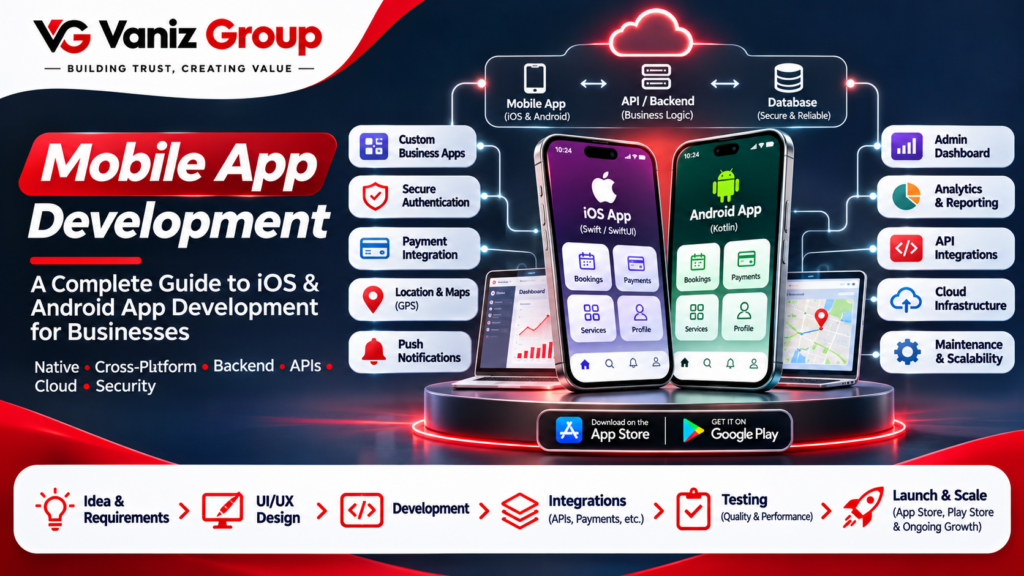
Mobile applications have become an important part of how businesses connect with customers, deliver services and manage their operations. From online shopping and banking to healthcare, education, transportation and business management, mobile apps are transforming the way people interact with digital products.
For businesses, a mobile application can provide more than just a presence on smartphones. It can create new opportunities to reach customers, improve user experiences, automate processes and deliver services more conveniently.
Whether you are a startup planning to launch a new app, an established company looking to expand its digital services or an organisation seeking to improve internal operations, choosing the right mobile app development approach is essential.
Professional mobile app development involves much more than writing code. It requires business planning, user experience design, technology selection, backend development, testing, deployment and ongoing maintenance.
At Vaniz Group, we help businesses turn their ideas into functional digital solutions through mobile app development, custom software engineering, API integration and modern application technologies.
In this guide, we explore mobile app development, iOS and Android applications, development technologies, key features, costs, benefits and how to choose the right mobile app development company.
1. What Is Mobile App Development?
Mobile app development is the process of designing, building, testing and maintaining applications that run on mobile devices such as smartphones and tablets.
A mobile application can be developed to provide customers with a service, support business operations, process transactions, manage information or connect users through a digital platform.
Businesses across different industries use mobile applications for purposes such as:
- Online shopping and e-commerce.
- Food ordering and delivery.
- Healthcare and appointment management.
- Banking and financial services.
- Education and online learning.
- Transportation and logistics.
- Customer relationship management.
- Business operations and employee management.
- Booking and reservation systems.
- Communication and social networking.
The functionality and architecture of an application depend on its intended users, business requirements and technical objectives.
A successful mobile app should provide a reliable, intuitive and convenient experience while supporting the business goals behind the product.
2. iOS App Development for Apple Devices
iOS app development involves creating applications for Apple’s mobile ecosystem, including iPhone and supported iPad devices.
Businesses often choose iOS application development when they want to provide customers with a dedicated experience for Apple devices.
A professional iOS application can include features such as:
- User registration and secure authentication.
- Personalised user dashboards.
- Push notifications.
- In-app purchases and payments.
- Location-based services.
- Camera and media functionality.
- API and third-party integrations.
- Real-time communication.
- Booking and appointment management.
- Data synchronisation.
Native iOS App Development
Native iOS applications are developed specifically for Apple’s platforms using technologies designed for the Apple ecosystem.
Common technologies include:
Swift: Apple’s modern programming language for building iOS applications. It supports modern application development and is widely used for native iPhone and iPad apps.
Objective-C: An established programming language used in Apple’s development ecosystem and in maintaining or extending existing iOS applications.
Apple Development Frameworks: Frameworks such as SwiftUI and UIKit support the development of application interfaces and interactions.
Native iOS development can be a suitable choice for applications requiring deep integration with Apple device capabilities, platform-specific functionality or specialised performance requirements.
3. Android App Development
Android app development focuses on building applications for smartphones and tablets running the Android operating system.
Android applications allow businesses to reach users across a wide range of devices and manufacturers.
Depending on the requirements, an Android app may include:
- User accounts and profile management.
- Push notifications.
- Payment gateway integration.
- GPS and location-based functionality.
- Product and service catalogues.
- Search and filtering.
- Online bookings.
- Real-time messaging.
- Media uploads.
- Dashboard and reporting features.
Android development commonly uses technologies such as Kotlin and Java, together with Android development frameworks and tools.
A well-developed Android application should consider different device specifications, screen sizes, operating system versions and performance requirements.
4. Cross-Platform Mobile App Development
Businesses that want to launch applications for both Android and iOS may consider cross-platform development.
Cross-platform technologies allow developers to share a significant portion of the application code across multiple platforms.
This can help reduce duplicated development work and simplify certain aspects of maintenance.
Two widely used technologies are:
Flutter App Development
Flutter is a cross-platform UI framework developed by Google. It uses the Dart programming language and allows developers to build applications for multiple platforms using a shared codebase.
Flutter can be useful for:
- Business applications.
- E-commerce apps.
- Booking platforms.
- Customer-facing applications.
- Service marketplaces.
- Internal management tools.
It provides a flexible approach to building consistent user interfaces across supported platforms.
React Native App Development
React Native is a framework for building mobile applications using React and JavaScript or TypeScript.
It allows development teams to share application logic and components across supported mobile platforms.
React Native may be suitable for applications that benefit from a shared codebase and integration with modern JavaScript-based development systems.
Native vs Cross-Platform Development
Both approaches offer advantages, and the right choice depends on the project.
Native development may be appropriate when an application requires extensive platform-specific features or specialised device integration.
Cross-platform development may be appropriate when a business wants to support multiple platforms while sharing more development resources.
The decision should consider performance, functionality, development budget, maintenance and long-term product plans.
5. Custom Mobile App Development for Businesses
Every business has different requirements. Some organisations need a simple customer-facing application, while others require complex platforms with multiple user roles, payment systems and backend integrations.
Custom mobile app development makes it possible to build an application around specific business processes and customer expectations.
Examples include:
E-commerce Mobile Applications
E-commerce apps allow customers to browse products, manage shopping carts, place orders and complete payments through mobile devices.
Common features include product catalogues, search filters, customer accounts, order tracking, promotional offers and payment integration.
On-Demand Service Applications
On-demand apps connect customers with service providers.
Examples include home service platforms, vehicle maintenance applications, delivery systems and professional booking services.
These applications may include location services, service listings, provider profiles, quote requests, booking management and notifications.
Healthcare Applications
Healthcare apps can support appointment scheduling, patient communication, health service information and administrative workflows.
Depending on the project, they may integrate with external healthcare systems and require additional security and privacy considerations.
Business Management Applications
Businesses can use mobile applications to manage internal processes and access important information while working remotely or across multiple locations.
Possible features include task management, employee dashboards, inventory information, reporting and customer records.
Educational Applications
Education apps can provide learning materials, online courses, assessments, student accounts and progress tracking.
The application can be designed around the requirements of schools, training organisations or online learning businesses.
6. Essential Features of a Successful Mobile Application
A mobile application should be designed around its users and the purpose it is intended to serve.
While features vary from project to project, several capabilities are commonly required.
User Registration and Authentication
Secure account management allows users to create accounts, log in and manage their personal information.
Features may include email authentication, password recovery, multi-factor authentication and social login.
Intuitive User Interface
The interface should make it easy for users to understand the application and complete important tasks.
Clear navigation, consistent layouts and accessible design contribute to a better user experience.
Push Notifications
Push notifications allow applications to communicate important updates to users.
They may be used for booking confirmations, order updates, reminders, promotional messages and account notifications.
API Integration
APIs allow mobile applications to communicate with backend systems and external services.
For example, an application may connect to payment gateways, customer management systems, maps, booking platforms or other business software.
Payment Integration
Applications that sell products or services may require secure payment functionality.
Depending on the business model, payment features may include card payments, digital wallets, payment gateways, subscriptions and transaction history.
Location-Based Services
Location functionality can support applications that depend on geographic information.
Examples include delivery tracking, nearby service discovery, navigation, transport applications and location-based bookings.
Admin Dashboard
An administrative dashboard allows authorised staff to manage application information and monitor important activities.
It may include user management, content management, transaction records, reports, notifications and application settings.
Analytics and Reporting
Analytics help businesses understand how customers interact with their application.
Useful information may include active users, feature usage, customer journeys, transaction activity and retention trends.
These insights can support future product improvements.
7. The Mobile App Development Process
Developing a successful mobile application requires a structured process that connects business objectives with technical implementation.
At Vaniz Group, we believe every development project should begin with understanding what the business wants to achieve.
Step 1: Idea and Requirement Analysis
The first stage involves understanding the application idea, intended users and business requirements.
Important questions include:
- What problem will the application solve?
- Who will use the app?
- What features are essential?
- Which platforms are required?
- Does the application need a backend system?
- Will it require third-party integrations?
- What are the expected development and launch timelines?
A clear requirement document helps establish the project scope and priorities.
Step 2: UI/UX Design and Prototyping
Once the requirements are defined, the next stage is designing the application’s user experience and interface.
This may include user journeys, wireframes, screen layouts and interactive prototypes.
The objective is to create an application that is visually consistent, easy to navigate and suitable for its target audience.
Step 3: Technology Selection
The technology stack is selected according to the project’s functionality and technical requirements.
For example:
- Native iOS development may use Swift and Apple’s development frameworks.
- Android development may use Kotlin and Java.
- Cross-platform development may use Flutter or React Native.
- Backend development may use Node.js, Express.js or ASP.NET Core.
- Databases may include SQL Server, PostgreSQL or suitable NoSQL solutions.
- Cloud infrastructure may use Microsoft Azure or Amazon Web Services.
The best technology depends on the application rather than following a one-size-fits-all approach.
Step 4: Frontend and Backend Development
The development stage involves building the mobile application and its supporting systems.
Frontend development covers the screens, navigation and user interactions.
Backend development manages application logic, user accounts, data processing, APIs, databases and integrations.
For applications requiring an administration portal, a web-based dashboard may also be developed.
Step 5: API and Third-Party Integrations
Many mobile applications rely on external services to provide additional functionality.
Integrations may include:
- Payment gateways.
- Maps and location services.
- Email and SMS services.
- Push notification services.
- Social authentication.
- CRM and ERP systems.
- External business APIs.
Each integration should be implemented and tested according to its security and operational requirements.
Step 6: Testing and Quality Assurance
Testing is essential before an application is released.
The process may include:
- Functional testing.
- User interface testing.
- Device compatibility testing.
- Performance testing.
- API testing.
- Security testing.
- Usability testing.
- Regression testing.
Testing across relevant devices and operating system versions helps identify issues before the application reaches customers.
Step 7: App Store Deployment
After development and testing, the application can be prepared for release.
For iOS applications, this involves preparing the app for Apple’s App Store review process.
For Android applications, deployment commonly involves preparing the release for Google Play.
Store listings, application descriptions, screenshots, privacy information and other required details should be prepared according to the relevant platform guidelines.
App store approval is subject to the respective platform’s review requirements.
Step 8: Maintenance and Continuous Improvement
Mobile app development continues after launch.
Applications need regular maintenance, compatibility updates, bug fixes, security improvements and new functionality as business requirements evolve.
Monitoring customer feedback and application performance can help identify areas that need improvement.
8. Benefits of Investing in Mobile App Development
A well-planned mobile application can provide several benefits for businesses.
Improved Customer Engagement
A mobile application provides customers with a dedicated way to interact with your business.
Features such as notifications, personalised content and customer accounts can support ongoing engagement.
Convenient Access to Services
Customers can access services and information through their smartphones without needing to visit a physical location or use a desktop computer.
Better Business Efficiency
Mobile applications can simplify business processes such as booking management, customer communication, employee coordination and information sharing.
Stronger Brand Presence
A branded mobile application can provide a consistent digital experience and help customers interact with your business.
New Revenue Opportunities
Depending on the business model, applications can support online sales, subscriptions, in-app purchases, bookings and other revenue-generating activities.
Better Customer Insights
Application analytics can help businesses understand customer behaviour and identify opportunities to improve products and services.
Business Scalability
A well-designed mobile application and supporting backend can be expanded as the number of users and business requirements grow.
9. Mobile App Security and Performance
Security and performance are essential considerations in mobile application development.
Users expect applications to protect their information and operate reliably.
Important considerations include:
- Secure authentication and authorisation.
- Encrypted communication.
- Secure API implementation.
- Appropriate data storage practices.
- Protection against common security vulnerabilities.
- Regular dependency updates.
- Application performance monitoring.
- Backup and recovery planning.
- Compliance with applicable privacy requirements.
For businesses operating in the UK or serving UK customers, relevant data protection requirements, including UK GDPR and the Data Protection Act 2018 where applicable, should be considered during development.
Performance is equally important. Applications should be tested to ensure that screens load efficiently, user interactions remain responsive and backend communication works reliably.
10. How Much Does Mobile App Development Cost?
The cost of developing a mobile application depends on its complexity, features, design requirements and technology choices.
A basic application with limited functionality will generally require a different level of investment compared with a large platform involving multiple user roles, payment processing, real-time features and complex backend systems.
Important cost factors include:
Application complexity: The number of screens, features and workflows affects the overall development effort.
Platform selection: Developing for iOS, Android or both influences the development approach.
UI/UX design: Custom designs, interactive prototypes and complex interfaces can affect the project budget.
Backend development: Applications requiring databases, user management, APIs and administration systems need additional development work.
Third-party integrations: Payment gateways, maps, messaging systems and external APIs can increase project complexity.
Security requirements: Applications handling sensitive information may require additional security and testing measures.
Testing and deployment: Device testing, platform compatibility and app store preparation are important parts of the overall project.
Maintenance: Ongoing updates, hosting, monitoring and technical support should also be considered.
Before starting development, businesses should define their essential features and request a clear project scope with estimated costs and timelines.
11. How to Choose the Right Mobile App Development Company
Choosing a mobile app development partner can have a significant impact on the quality and long-term success of your application.
Before selecting a development company, consider the following factors.
Technical Experience
Look for a team familiar with the technologies required for your project, such as Swift, Objective-C, Flutter, React Native, Kotlin, Node.js and .NET.
Relevant Portfolio
Review examples of previous applications and software projects. Look for experience with similar functionality, industries or technical requirements.
Development Process
A professional development process should cover requirement analysis, design, development, testing, deployment and maintenance.
Communication
Clear communication helps prevent misunderstandings and keeps business requirements aligned throughout development.
Security Practices
Discuss how the development team approaches authentication, data protection, API security and application testing.
Ownership and Documentation
Clarify ownership of the source code, design assets, application accounts and technical documentation.
Post-Launch Support
Ask about bug fixes, updates, operating system compatibility and ongoing maintenance arrangements.
A suitable development partner should understand both the technical requirements and the business objectives behind your application.
12. Why Choose Vaniz Group for Mobile App Development?
Vaniz Group provides software and mobile application development services for businesses looking to build practical digital solutions.
We work with different technologies and development approaches to create applications based on project requirements, target users and business objectives.
Our mobile app development capabilities include:
iOS App Development: Development of applications for Apple’s ecosystem using Swift, Objective-C and relevant iOS frameworks.
Android App Development: Development of Android applications with functionality suited to different business requirements and devices.
Flutter App Development: Cross-platform application development using Flutter for businesses looking to support multiple platforms.
Custom Mobile App Development: Applications designed around specific business workflows, customer needs and product ideas.
Backend and API Development: Supporting mobile applications with backend services, database systems, REST APIs and third-party integrations.
UI/UX Design: Planning and designing user-friendly mobile interfaces and application journeys.
Cloud Integration: Connecting applications with cloud infrastructure and services where required.
Ongoing Maintenance: Supporting application improvements, technical updates and future development requirements.
We also provide wider software development capabilities, including web applications, custom business software, ERP solutions, cloud services and API integrations.
Whether you are a startup planning a new mobile product or an established business looking to modernise your digital services, Vaniz Group can help you explore a suitable development approach.
Final Thoughts
Mobile applications have become valuable tools for businesses looking to improve customer experiences, provide convenient services and strengthen their digital presence.
Whether you need an iOS application, Android app or cross-platform mobile solution, the right development approach depends on your target users, business requirements and long-term objectives.
A successful mobile application requires thoughtful planning, intuitive design, reliable engineering, secure integrations and continuous improvement after launch.
Choosing an experienced development partner can help turn your idea into a practical digital product.
Planning to build a mobile application for your business?
Vaniz Group can help you explore your requirements and develop a mobile solution aligned with your goals.
Get in touch with Vaniz Group to discuss your iOS, Android or cross-platform app development project.
Website: https://vanizgroup.uk/