

Software is changing how businesses operate, serve customers and manage everyday processes. From customer relationship management (CRM) systems and accounting platforms to project management tools and industry-specific applications, businesses increasingly rely on software that can be accessed online without installing and maintaining applications on individual computers.
One of the technologies driving this transformation is Software as a Service (SaaS).
SaaS has become a popular software delivery model for startups, established companies and growing organisations. It allows businesses to access applications through the internet, often using a subscription-based pricing model. Instead of managing complex software installations and infrastructure, customers can use a centrally hosted platform that is maintained by the software provider.
For businesses looking to launch a digital product or modernise their operations, SaaS development offers significant opportunities.
In this guide, we explain what SaaS development involves, how SaaS applications work, their key benefits, essential features, development stages and what businesses should consider before building a SaaS product.
What Is SaaS Development?
Software as a Service (SaaS) is a software delivery model in which applications are hosted by a service provider and made available to customers over the internet.
Rather than purchasing and installing software locally, users typically access a SaaS application through a web browser or dedicated mobile application.
SaaS development is the process of planning, designing, building, testing, deploying and maintaining these cloud-based applications.
Examples of SaaS products include:
- Customer relationship management platforms.
- Project management applications.
- Accounting and invoicing software.
- Human resource management systems.
- Online booking and appointment platforms.
- Inventory and business management systems.
- Marketing automation tools.
- Industry-specific business platforms.
A SaaS application can serve individual customers, small businesses or large enterprises, depending on its purpose and architecture.
How Does a SaaS Application Work?
A SaaS application generally operates through a centralised cloud-based infrastructure.
The software provider hosts and maintains the application, while customers access its functionality through an internet connection.
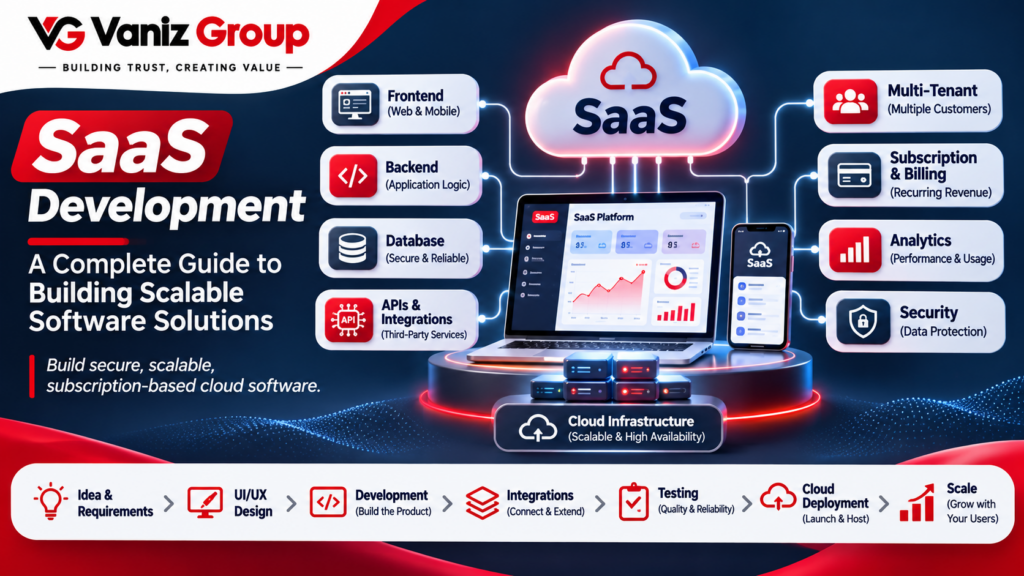
A typical SaaS environment includes several components:
1. Frontend application: This is the user-facing interface through which customers interact with the software. It may be a web application, mobile application or both.
2. Backend system: The backend handles application logic, user permissions, business processes, data processing and communication between different components.
3. Database: The database stores information such as user accounts, customer records, transactions, settings and application data.
4. Cloud infrastructure: Hosting infrastructure provides the computing resources required to run the application and make it accessible to users.
5. APIs and integrations: APIs allow the SaaS application to communicate with third-party services, payment gateways, communication tools and other business systems.
6. Administration and monitoring: Management tools help the provider monitor performance, manage subscriptions, maintain security and support customers.
Together, these components create a software platform that can be accessed by multiple customers while maintaining appropriate separation of their information and permissions.
Key Benefits of SaaS Development for Businesses
SaaS development offers several advantages for businesses planning to launch digital products or improve internal operations.
1. Lower Initial Infrastructure Requirements
Traditional software solutions may require organisations to purchase hardware, install applications and maintain their own infrastructure.
With a SaaS model, the application is generally hosted in the cloud. This reduces the need for customers to manage their own software infrastructure.
For software providers, cloud hosting can also offer flexible infrastructure options that support the growth of the application.
2. Access from Different Locations
SaaS applications can typically be accessed through an internet connection, allowing authorised users to work from different locations and devices.
This is particularly useful for businesses with remote employees, multiple branches or teams working across different regions.
3. Subscription-Based Revenue Opportunities
A SaaS business can generate recurring revenue through subscription plans.
For example, a provider might offer monthly or annual packages with different features, user limits or usage allowances.
Common pricing approaches include:
- Free and premium plans.
- Monthly subscriptions.
- Annual subscriptions.
- Usage-based pricing.
- Tiered plans for different business sizes.
- Enterprise pricing based on requirements.
The right pricing model depends on the target market, product value, operating costs and customer expectations.
4. Easier Software Updates
Since SaaS applications are centrally managed, providers can deploy updates and improvements without requiring every customer to manually install a new version.
This can simplify maintenance and help keep users on a consistent application version.
5. Scalability
A well-designed SaaS platform can be expanded as the number of customers, users and transactions increases.
Cloud infrastructure and scalable application architecture can help businesses adjust computing resources according to demand.
However, scalability must be considered during the initial design and development process.
6. Centralised Data and Management
SaaS platforms can provide centralised tools for managing users, records, workflows and business activities.
This can improve visibility and help organisations manage their operations more efficiently.
Essential Features of a Successful SaaS Application
A successful SaaS product needs more than an attractive interface. It should provide reliable functionality, secure data management and a user experience that meets customer expectations.
Here are some important features to consider.
1. User Registration and Authentication
SaaS applications should provide secure user registration and login functionality.
Common authentication features include:
- Email and password authentication.
- Multi-factor authentication.
- Password recovery.
- Social login, where appropriate.
- Session management.
- Role-based access control.
These features help protect accounts and control access to application resources.
2. Multi-Tenant Architecture
Multi-tenancy is a common architecture used in SaaS applications.
It allows multiple customers, often referred to as tenants, to use the same application infrastructure while keeping their data and configurations appropriately separated.
For example, a SaaS CRM platform may allow hundreds of businesses to use one application while ensuring that each organisation can access only its own customer records.
Multi-tenant architecture can reduce infrastructure duplication and simplify application maintenance.
The appropriate approach depends on security requirements, compliance needs and the nature of the product.
3. Subscription and Billing Management
For subscription-based SaaS products, billing functionality is essential.
A subscription management system may include:
- Different pricing plans.
- Monthly and annual billing.
- Free trials.
- Subscription upgrades and downgrades.
- Payment processing.
- Invoice generation.
- Renewal management.
- Cancellation handling.
- Payment failure notifications.
Integrating a suitable payment gateway can help automate recurring payments and reduce manual administration.
4. Admin Dashboard
An administration dashboard gives platform owners and authorised staff visibility into application activity.
Depending on the product, it may provide:
- User management.
- Subscription monitoring.
- Revenue reports.
- Usage analytics.
- Account management.
- System notifications.
- Role and permission controls.
- Configuration settings.
A well-designed dashboard makes it easier to manage the platform as the customer base grows.
5. Reporting and Analytics
Analytics can help customers understand how they use the software and identify areas for improvement.
A SaaS application may include reports on sales, customer activity, operational performance, user engagement or other product-specific information.
The most useful analytics are those directly connected to the problems the application is designed to solve.
6. Third-Party Integrations
Many businesses already use different software systems to manage their operations.
API integrations allow SaaS applications to connect with external services such as:
- Payment gateways.
- Email platforms.
- Accounting software.
- CRM systems.
- Communication tools.
- Marketing platforms.
- Cloud storage services.
These integrations can reduce repetitive work and make the SaaS product more useful within existing business workflows.
7. Security and Data Protection
Security is a fundamental requirement for SaaS development.
A SaaS platform may store personal information, business records, payment-related information and other sensitive data.
Important security considerations include:
- Secure authentication.
- Role-based permissions.
- Encryption in transit and at rest where appropriate.
- Secure API design.
- Input validation.
- Regular security updates.
- Backup and recovery procedures.
- Activity logging and monitoring.
- Protection against common application vulnerabilities.
Businesses serving customers in the UK should also consider applicable data protection requirements, including the UK GDPR and Data Protection Act 2018, where relevant.
Security should be considered throughout development rather than added only after the application is completed.
The SaaS Development Process: Step by Step
Developing a SaaS product requires a structured approach. The process should begin with understanding the business problem and end with continuous improvement after launch.
Step 1: Identify the Business Idea and Target Market
The first step is to define what the SaaS product will achieve.
Businesses should identify:
- The problem the software will solve.
- The intended target customers.
- Existing alternatives and competitors.
- The product’s main value proposition.
- Potential pricing models.
- Expected customer requirements.
Market research is important because a technically impressive application may still struggle if it does not address a genuine customer need.
Step 2: Define the Product Requirements
Once the idea is clear, the next step is to document the product requirements.
This includes defining the features, user roles, workflows, integrations and technical expectations.
It is useful to separate features into three categories:
Essential features: Functionality required for the initial product launch.
Important improvements: Features that improve the customer experience but may be introduced later.
Future enhancements: Advanced functionality that can be developed as the product grows.
This approach helps control development scope and prioritise the most valuable features.
Step 3: Design the User Experience and Interface
User experience plays a major role in SaaS adoption.
The application should be easy to navigate, responsive across devices and designed around the needs of its intended users.
The design process may include:
- User journey planning.
- Wireframes.
- Dashboard layouts.
- Interactive prototypes.
- Responsive interface design.
- Usability reviews.
A simple and intuitive interface can help reduce the learning curve and improve customer satisfaction.
Step 4: Choose the Right Technology Stack
The technology stack should support the application’s functionality, security, scalability and long-term maintenance.
Depending on project requirements, a SaaS solution may use technologies such as:
- Frontend: React.js, Angular, Vue.js or Next.js.
- Backend: Node.js, Express.js, ASP.NET Core or other suitable backend frameworks.
- Programming languages: JavaScript, TypeScript, C# and others.
- Databases: PostgreSQL, SQL Server, MySQL or MongoDB.
- Cloud infrastructure: Microsoft Azure, Amazon Web Services or other cloud providers.
- APIs: REST or GraphQL.
- Deployment and automation: Docker, CI/CD pipelines and infrastructure management tools.
There is no single technology stack that suits every SaaS product. The selection should be based on the project’s actual requirements and the development team’s ability to maintain it.
Step 5: Develop the Frontend and Backend
During development, the frontend and backend components are built and connected.
The frontend provides the user interface, while the backend handles application logic, data operations, authentication and integrations.
Developers should also implement the required database structure, permissions, subscription functionality and business workflows.
A modular and maintainable architecture can make future enhancements easier.
Step 6: Implement Security and Integrations
Security features and third-party integrations should be incorporated into the development process.
This may include payment gateway integration, email notifications, external APIs, access permissions and data protection measures.
Each integration should be tested to ensure that information is transferred correctly and securely.
Step 7: Testing and Quality Assurance
Before launch, the SaaS application should go through comprehensive testing.
Important testing activities include:
- Functional testing.
- User interface testing.
- API testing.
- Database testing.
- Security testing.
- Performance testing.
- Compatibility testing.
- User acceptance testing.
Testing helps identify problems before customers begin using the application.
Step 8: Cloud Deployment and Launch
After testing, the application can be deployed to the selected hosting environment.
The launch process may include configuring production infrastructure, domain settings, SSL certificates, databases, monitoring and backup systems.
A controlled launch can help identify issues and gather early customer feedback.
Step 9: Maintenance and Continuous Improvement
SaaS development does not end when the application goes live.
The platform needs ongoing monitoring, bug fixes, security updates, infrastructure management and feature improvements.
Customer feedback and usage data can help identify opportunities to improve the product over time.
SaaS Development Challenges Businesses Should Consider
Although SaaS offers significant opportunities, building and operating a successful platform involves several challenges.
Data Security and Privacy
The application must protect customer information and provide suitable access controls. Businesses should understand their responsibilities around data handling, storage and privacy.
Scalability and Performance
An application that works well with a small number of users may experience performance problems as demand increases. Architecture and infrastructure should be planned to accommodate expected growth.
Multi-Tenant Data Isolation
When multiple organisations use the same platform, their data must remain appropriately separated. Incorrect permission checks or database design can create serious security risks.
Ongoing Maintenance Costs
Cloud hosting, development, monitoring, support and third-party services create ongoing operating costs. These should be considered when planning subscription pricing.
Customer Retention
Attracting customers is only one part of building a SaaS business. The product must continue providing value so customers have a reason to renew their subscriptions.
Competition
Many SaaS markets contain established competitors. A new product needs a clear value proposition, a defined target audience and features that solve customer problems effectively.
How Much Does SaaS Development Cost?
The cost of SaaS development depends on the complexity, functionality and technical requirements of the application.
A basic SaaS MVP may require fewer features and integrations, while a more advanced enterprise platform may involve complex workflows, multiple user roles, extensive integrations and sophisticated infrastructure.
Factors that influence development costs include:
- Number and complexity of features.
- UI/UX design requirements.
- Frontend and backend development.
- Database and architecture design.
- Multi-tenant functionality.
- Payment and subscription integration.
- Security and compliance requirements.
- Cloud hosting and deployment.
- Testing and quality assurance.
- Ongoing maintenance and support.
Businesses should avoid selecting a development partner based only on the lowest initial quotation. A clear scope, maintainable architecture and reliable development process can have a significant impact on the long-term success of the product.
Why Choose Vaniz Group for SaaS Development?
Building a SaaS application requires a combination of technical expertise, business understanding and a structured development approach.
Vaniz Group provides software development services for businesses looking to create custom digital solutions, web applications and business platforms.
Our development capabilities include technologies and services such as Node.js, .NET Core, C#, Angular, React.js, Vue.js, Next.js, REST APIs, database development, cloud services and third-party integrations.
We focus on understanding project requirements and developing software solutions around specific business objectives.
Whether you are a startup planning your first SaaS product or an established business looking to develop a custom cloud-based platform, the development process should be aligned with your goals, users and future requirements.
Vaniz Group can support SaaS development projects through key stages such as:
- Requirement analysis: Understanding your business idea, target users and product requirements.
- UI/UX design: Planning intuitive interfaces and user journeys.
- Custom software development: Building frontend and backend functionality around your requirements.
- API and integration development: Connecting your platform with payment services and other business systems.
- Cloud deployment: Supporting deployment and infrastructure configuration.
- Testing and quality assurance: Evaluating functionality, reliability and performance.
- Ongoing improvements: Supporting maintenance and future development requirements.
Our goal is to help businesses turn software ideas into practical digital products.
Final Thoughts
SaaS development has created new opportunities for businesses to build digital products, deliver software online and introduce recurring revenue models.
From CRM systems and booking platforms to enterprise applications and specialised business tools, SaaS solutions can support different industries and operational requirements.
However, building a successful SaaS product requires more than writing code. It involves understanding the target market, selecting the right technology, designing a reliable architecture, protecting customer data and continuously improving the platform.
With the right planning and development partner, businesses can create SaaS applications that address real problems and support long-term growth.
Planning to build your own SaaS application?
Speak with Vaniz Group about your software idea and explore how a custom SaaS solution can support your business objectives.
Website: https://vanizgroup.uk/
Contact Vaniz Group to discuss your SaaS development requirements.